

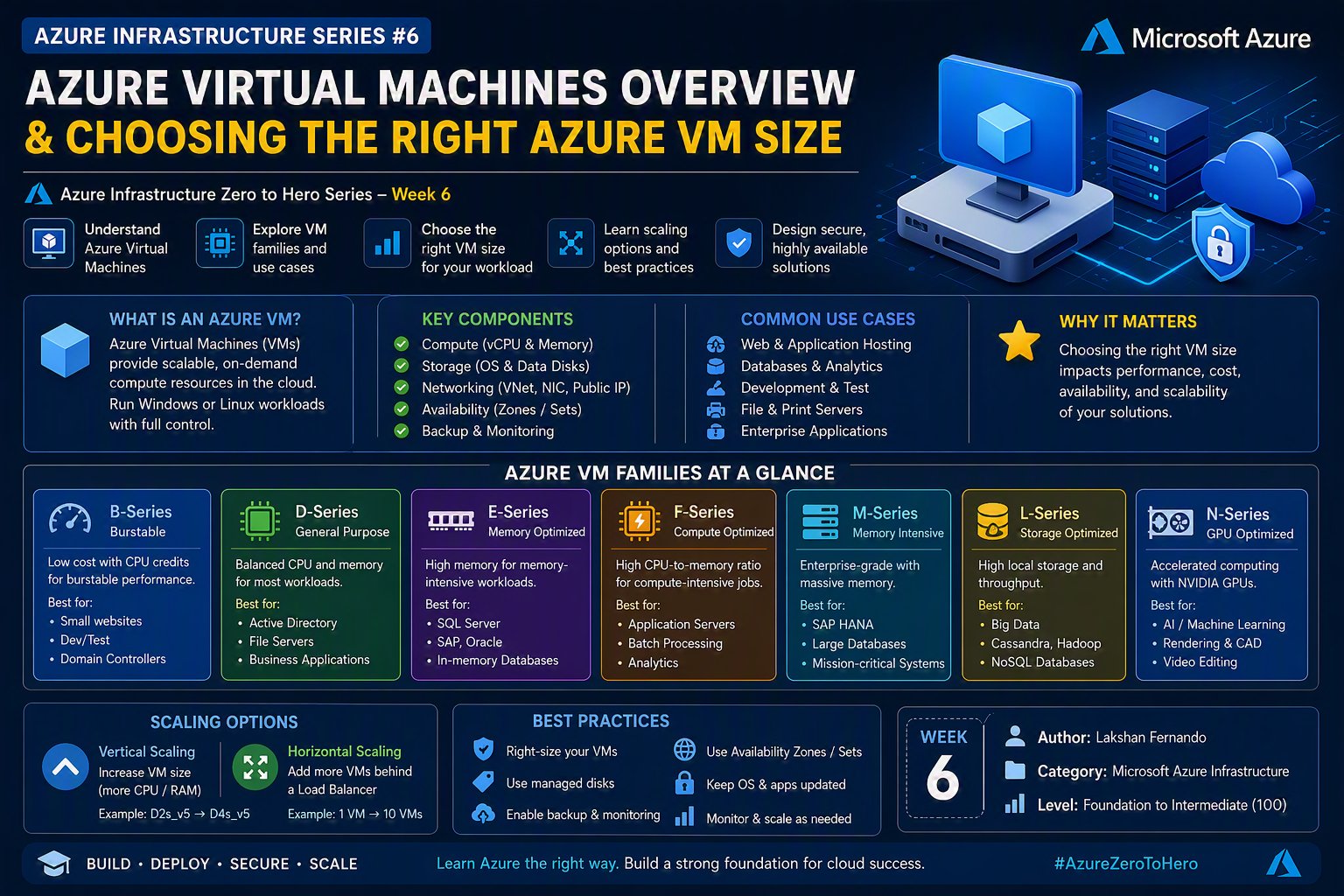
Azure Infrastructure Zero to Hero Series – Week 6
Author: Lakshan Fernando
Category: Microsoft Azure Infrastructure
Level: Foundation to Intermediate (100)
Azure Virtual Machines: Everything You Need to Know and How to Choose the Right VM Size
Cloud computing has transformed the way organizations deploy applications, but not every workload can immediately move to platform as a service (PaaS) or containers. Many business applications still require full operating system control, legacy software support, custom security configurations, or specialized hardware. This is where Azure Virtual Machines (Azure VMs) become one of Microsoft's most powerful Infrastructure as a Service (IaaS) offerings.
Azure Virtual Machines provide scalable, secure, and highly available computing resources that eliminate the need to purchase, maintain, or refresh physical servers. Whether you're migrating an existing datacentre, deploying enterprise applications, building development environments, or running high-performance workloads, Azure VMs provide the flexibility to meet virtually any business requirement.
In this article, we'll explore Azure Virtual Machines from the ground up, understand how they work, examine the different VM families, and learn how to choose the right VM size for your workloads while optimizing cost and performance.
What is an Azure Virtual Machine?
An Azure Virtual Machine is a software-based computer running inside Microsoft's global cloud infrastructure.
Just like a physical server, an Azure VM includes:
- CPU
- Memory (RAM)
- Storage
- Network interfaces
- Operating System
- Applications
The difference is that Microsoft manages the physical hardware, while you manage everything inside the virtual machine.
This follows the shared responsibility model, where Microsoft is responsible for:
- Physical datacentres
- Hardware maintenance
- Networking infrastructure
- Hypervisor
- Physical security
Customers are responsible for:
- Operating System
- Applications
- Updates
- Security
- Antivirus
- Data
- User access
- Backup configuration
Think of Azure Virtual Machines as renting powerful enterprise servers only when you need them instead of buying expensive hardware.
Azure VM Architecture
A typical Azure VM consists of multiple Azure resources working together.

Every component can be managed independently.
Components of an Azure VM
Virtual Machine
The compute resource that runs your operating system.
Examples:
- Windows Server
- Ubuntu
- Red Hat Enterprise Linux
- SUSE Linux
- Debian
Managed Disks
Azure stores VM disks separately from compute resources.
Types include:
OS Disk
Contains:
- Operating System
- Boot partition
- System files
Data Disk
Stores:
- Databases
- Application files
- User data
- Logs
Temporary Disk
Provides:
- High-speed temporary storage
- Page files
- Cache
- Scratch data
Important:
Temporary disks are not persistent.
Data will be lost if the VM is moved or redeployed.
Network Interface (NIC)
Every VM requires at least one NIC.
The NIC connects the VM to:
- Virtual Network
- NSGs
- Load Balancer
- Public IP
Multiple NICs are supported for certain VM sizes.
Public IP Address
Optional.
Required only if the VM needs direct internet connectivity.
Examples:
- Bastion replacement (not recommended)
- Testing
- Public web servers
Best practice:
Avoid assigning Public IPs whenever possible.
Use:
- Azure Bastion
- VPN Gateway
- ExpressRoute
- Jump Servers
Virtual Network (VNet)
Every Azure VM belongs to a subnet inside a Virtual Network.
VNets provide:
- Private communication
- DNS
- Routing
- Isolation
Azure VM Deployment Models
Azure supports several deployment options.
Azure Portal
Best for beginners.
GUI-based deployment.
Azure CLI
Example:
az vm create
Azure PowerShell
Example:
New-AzVM
ARM Templates
Infrastructure as Code.
Repeatable deployments.
Bicep
Microsoft's modern Infrastructure as Code language.
Cleaner than ARM JSON.
Terraform
Popular multi-cloud Infrastructure as Code tool.
VM Images
Azure Marketplace provides thousands of ready-to-use images.
Examples include:
Windows
- Windows Server 2025
- Windows Server 2022
- SQL Server
- Visual Studio
Linux
- Ubuntu
- Debian
- Red Hat
- Oracle Linux
- SUSE
Applications
- WordPress
- Jenkins
- Docker
- Kubernetes Nodes
You can also upload your own custom images.
Azure VM Availability Options
Keeping applications online is critical.
Azure offers multiple options.
Availability Sets
Protect against:
- Planned maintenance
- Hardware failures
Uses:
- Fault Domains
- Update Domains
Typically provides 99.95% SLA.
Availability Zones
Separate physical datacenters within the same Azure region.
Benefits:
- Higher resiliency
- Fault isolation
Supports 99.99% SLA.
Virtual Machine Scale Sets (VMSS)
Automatically creates and manages multiple VM instances.
Perfect for:
- Web servers
- APIs
- Application farms
Supports:
- Auto Scaling
- Load Balancing
- Rolling updates
VM Storage Performance
Azure offers several managed disk options.
|
Disk Type |
Best For |
|
Standard HDD |
Archive, Backup |
|
Standard SSD |
General workloads |
|
Premium SSD |
Production applications |
|
Premium SSD v2 |
High-performance databases |
|
Ultra Disk |
Mission-critical databases |
Azure VM Pricing
Azure VM pricing depends on:
- VM Size
- Operating System
- Region
- Storage
- Network
- Reserved Instances
- Spot VM usage
Remember:
Stopping a VM inside Windows does not stop billing.
You must:
Stop (Deallocate)
from Azure Portal or Azure CLI.
Choosing the Right Azure VM Size
One of the most common mistakes organizations make is selecting the wrong VM size.
Choosing a VM that is too small causes:
- Slow performance
- High CPU
- Application crashes
Choosing a VM that is too large results in:
- Higher monthly costs
- Wasted resources
Microsoft provides dozens of VM families, each optimized for different workloads.
Understanding VM Naming
Example:
Standard_D4s_v5
Meaning:
|
Component |
Meaning |
|
D |
General Purpose |
|
4 |
vCPUs |
|
s |
Premium SSD Support |
|
v5 |
Generation |
Azure VM Families
B-Series (Burstable)
Best for:
- Small websites
- Test environments
- Development
- Domain Controllers
- Low CPU applications
Characteristics:
- Low cost
- CPU credits
- Burstable performance
Not suitable for constant high CPU workloads.
D-Series (General Purpose)
The most commonly used VM family.
Ideal for:
- Active Directory
- File Servers
- IIS
- Business applications
- Medium SQL Servers
Balanced CPU and memory.
E-Series (Memory Optimized)
Designed for:
- SQL Server
- SAP
- Oracle
- Redis
- Large in-memory databases
Provides significantly more RAM.
F-Series (Compute Optimized)
Designed for:
- Application servers
- Gaming servers
- Batch processing
- Analytics
Higher CPU-to-memory ratio.
M-Series
Enterprise-scale workloads.
Examples:
- SAP HANA
- Large databases
- Mission-critical systems
Supports several terabytes of RAM.
L-Series
Storage optimized.
Best for:
- Big Data
- Cassandra
- Hadoop
- NoSQL databases
Provides extremely high disk throughput.
N-Series
GPU-enabled VMs.
Used for:
- AI
- Machine Learning
- Deep Learning
- CAD
- Rendering
- Video Editing

Selecting the Correct VM
Start with workload requirements.
Ask yourself:
How many users?
- 20 users
- 200 users
- 2000 users
CPU Usage
High?
Low?
Constant?
Bursting?
Memory Requirements
Applications like SQL Server require significant RAM.
Storage Performance
Does the workload require:
- HDD
- SSD
- Premium SSD
- Ultra Disk
Network Throughput
Some applications require:
- High bandwidth
- Low latency
Future Growth
Always leave room for scaling.
Azure allows resizing VMs later.
Common VM Recommendations
|
Workload |
Recommended VM Family |
|
Active Directory |
B-Series or D-Series |
|
DNS |
B-Series |
|
File Server |
D-Series |
|
IIS Web Server |
D-Series |
|
SQL Server |
E-Series |
|
SAP |
M-Series |
|
AI Training |
N-Series |
|
Jenkins |
D-Series |
|
Dev/Test |
B-Series |
|
Azure DevOps Agent |
B-Series |
Rightsizing Best Practices
Never select VM sizes based only on guesswork.
Instead:
- Monitor CPU utilization
- Monitor Memory usage
- Analyze Disk IOPS
- Review Network throughput
- Enable Azure Monitor
- Review Azure Advisor recommendations
Azure Advisor can identify:
- Oversized VMs
- Underutilized VMs
- Cost-saving opportunities
- Performance recommendations
Vertical vs Horizontal Scaling
Vertical Scaling
Increase VM size.

Simple but may require a restart.
Horizontal Scaling
Add more VMs behind a Load Balancer.

Provides:
- Better scalability
- Higher availability
- Fault tolerance
Often implemented using Virtual Machine Scale Sets.
Cost Optimization Tips
Reduce Azure VM costs by following these practices:
- Stop and deallocate unused VMs.
- Use Azure Advisor recommendations.
- Select the correct VM family.
- Choose reserved instances for long-running workloads.
- Use Azure Hybrid Benefit if you have eligible Windows Server licenses.
- Use Spot VMs for interruptible workloads such as testing, CI/CD, or batch processing.
- Regularly review performance metrics and resize underutilized VMs.
- Use Autoscale with VM Scale Sets for dynamic workloads.
Security Best Practices
Protect Azure Virtual Machines by implementing:
- Microsoft Defender for Cloud
- Just-in-Time (JIT) VM Access
- Azure Bastion instead of Public IPs
- Network Security Groups (NSGs)
- Azure Disk Encryption
- Managed Identities
- Azure Backup
- Automatic OS patching
- Microsoft Entra ID authentication where applicable
- Least privilege using Azure RBAC
Monitoring Azure Virtual Machines
Continuous monitoring helps maintain performance and availability.
Use Azure Monitor to track:
- CPU utilization
- Memory usage (via Azure Monitor Agent)
- Disk latency and IOPS
- Network throughput
- Boot diagnostics
- Guest OS metrics
- Event logs
- Performance trends
Integrate with Log Analytics and Azure Alerts to proactively detect issues before they impact users.
Final Thoughts
Azure Virtual Machines remain one of the most versatile and widely used services in Microsoft Azure. They provide organizations with the flexibility to migrate existing applications, host enterprise workloads, and build scalable cloud infrastructure without investing in physical hardware.
However, deploying a VM is only the beginning. Selecting the appropriate VM family and size is equally important for achieving the right balance between performance, availability, and cost. By understanding workload characteristics, leveraging Azure Advisor recommendations, monitoring resource utilization, and applying Azure best practices, organizations can maximize the value of their Azure investments.
As your cloud environment evolves, regularly revisit your VM sizing strategy. Azure makes it easy to scale resources up or down, allowing you to adapt to changing business requirements while maintaining operational efficiency and controlling costs.


No comments yet. Be the first to share your thoughts!